This story a happy ending. It’s about hundreds of people coming together to have fun and delight in each other’s company. They’ll have some friendly competition and raise money for a good cause. But before I get to the snowmobiles and their breathtaking speeds, or the sounds of happy children, or the laughter around the fire, let me tell you something I learned about myself while reporting this story: under no circumstances will I be parking my car on a frozen lake.
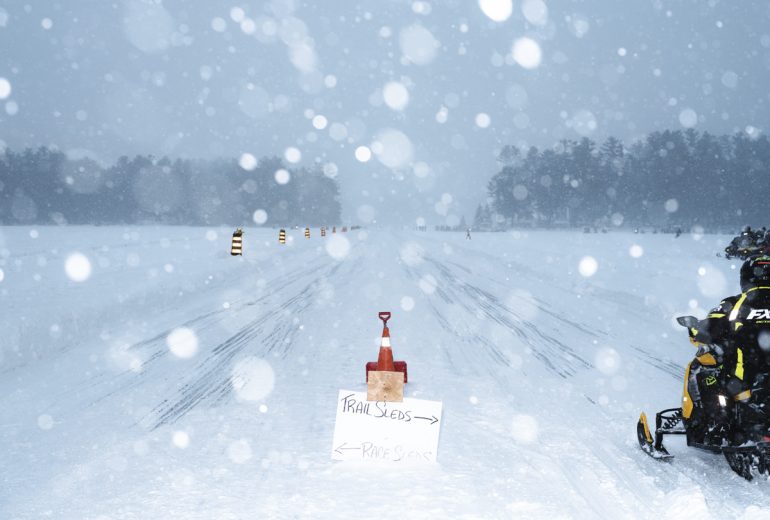 Photo by Alexi Hobbs
Being a journalist pushes you to the very precipice of your curiosity. And there, on the edge of Benoir Lake, near Bancroft, Ont., I found mine. When I pull up to my destination on a freezing February morning and ask for Angelo, someone politely gestures to the end of the driveway. “Park on the lake,” the man tells me. “You can’t miss him.”
I thank the stranger then wedge my car in a tight driveway spot between a big truck and a giant snowbank. It ain’t perfect, but it’s solid ground. That’s where cars go. So imagine my surprise when I step on to the frozen lake and discover that not everyone shares this belief. There are nearly a dozen trucks and trailers casually parked across a frozen expanse. As if it was obvious to everyone that this surface is ready for large, heavy vehicles.
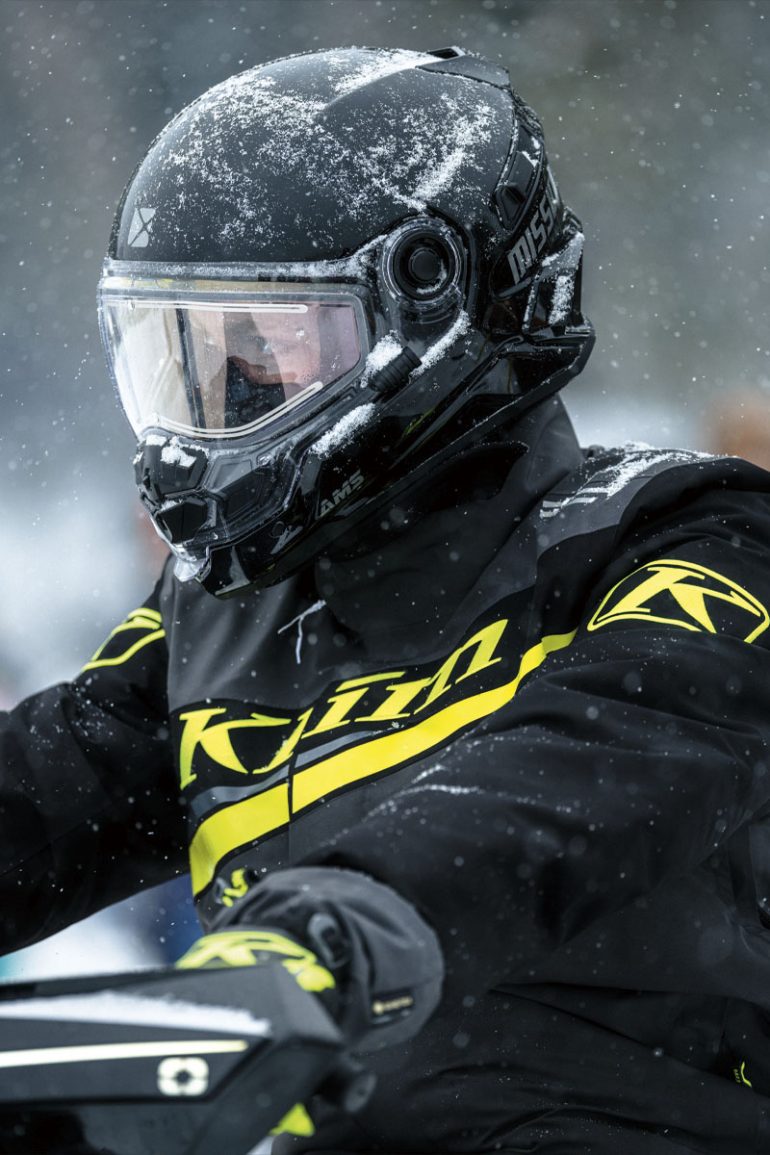 Photo by Alexi Hobbs
When I first find Angelo Bortolazzo, he’s on his knees, tending to a friend’s snowmobile. I’m eager to ask questions about the annual Benoir Lake Radar Run he orchestrates. This is the third year of the event, which means Angelo has developed a rhythm for what still needs to get ready. In a few hours, hundreds of snowmobiles will race down a track on the lake that he has spent weeks preparing. Mostly, they’ll be cottagers who arrive from across Benoir Lake, but also from neighbouring Elephant and Baptiste lakes. But some dedicated snowmobilers will have woken up early to load their sled onto a trailer, and then driven three or four hours from parts further afield in the unforgiving cold to get here.
The festivities haven’t started yet, though, and this morning, Angelo is something of a hummingbird, floating from one puzzle to another. Our conversation will have to wait, he tells me, because he has 20 other things to tend to. “This one just got a new turbo installed,” he gestures to the broken-down snowmobile. I nod like I know what that means. “But something blew out, so we’re waiting for another one.”
Every February, no matter how frigid the weather, these snowmobilers take to the ice to help their community
Every February, no matter how frigid the weather, these snowmobilers take to the ice to help their community
Henry Prins (below) is among the small army of Benoir Lakers and locals who help Angelo Bertolazzo organize and pull off the annual Radar Run.
Every February, no matter how frigid the weather, these snowmobilers take to the ice to help their community
Every February, no matter how frigid the weather, these snowmobilers take to the ice to help their community
The Benoir Lake Radar Run raises money
for the breakfast and lunch program at
nearby Wilberforce Elementary School
in multiple ways. Along with ticket sales
(three for $5), there’s a
50/50 draw and a food stand that feeds
the hungry sledders. “It’s nothing fancy,
just burgers, hot dogs, and chips,” says Angelo. “There are so many people
at this event...you can’t cater to everyone.” But nobody minds hot food on a cold
day. “It’s still a bite to eat on the lake,”
he points out. And because all the food
is donated, all the proceeds go to the school’s nutrition program.
Every February, no matter how frigid the weather, these snowmobilers take to the ice to help their community
Every February, no matter how frigid the weather, these snowmobilers take to the ice to help their community
I am struck by Angelo’s comfort around snowmobiles and fixing them. When someone has a problem with their sled, Angelo doesn’t hesitate to get into the engine to diagnose the problem. “I’ve been snowmobiling since I was 15,” he says. It’s an integral part of who he is. When he was diagnosed with esophageal cancer in 2020, Angelo and his wife, Brandi, left their home in Blackstock, Ont., and moved to the lake full time. It’s where he finds his peace. “We just decided to leave the rat race,” he says. A plumber and pipe fitter by trade, slowing down has given him the space he had been craving for snowmobiling.
The premise of the Radar Run is simple: snowmobilers pay a small fee to take a turn (“a run”) speeding down a track on the frozen lake—$5 will get you three runs. At the end of the course, someone with a radar gun will clock the racer’s top speed. May the fastest win. But Angelo has transformed this simple premise into an all-day winter festival that draws a steady crowd, pulls in help from his friends and neighbours, and raises thousands of dollars for a school nutrition program in nearby Wilberforce.
While Angelo turns his attention to something else, I inspect the start of the track, a clearing cleaved into two lanes—one marked “race sleds,” the other “trail sleds.” In other words, one for those ready for speed and one for amateurs who just want to see how fast they can go. You can quickly see that the track itself is work. Someone must tend to it to maintain the trail. That means not just clearing the snow, but riding, grooming, and shaving the track often to make sure it’s smooth. This is labour that usually starts about a month before the Radar Run, Angelo tells me. “Several times a week, I have to go out and maintain the track,” he says.
But this is winter we’re talking about—it’s not a predictable force. “Some days, I’m out there for 15 minutes. Some days it’s for five hours.” Three days before this year’s Radar Run, Benoir Lake gets 25 cm of snow, which means several hours per day clearing the track to make sure it’s ready for today. The day after the Radar Run, Benoir will be blanketed with another 25 cm of snow, which makes today something of a small miracle. A blizzardy, frigid one, at -14°C with the windchill. But a miracle nonetheless.
Henry Prins, a friend of Angelo’s, offers to give me a tour of the track. I accept, but decide to not tell Henry that this tour will be my first time on a snowmobile, ever. As I hold on to Henry for dear life, he tells me that for the past few weeks, he has been among the crew of people helping Angelo prepare the track. Henry’s a genial guy, the kind of guy who ends every statement with, “Right?” As in: “You have to hold on tight, right?” and “You gotta keep the track clear, right?” and “The fastest sleds need the track to be perfect or it’s not safe, right?”
I confess to Henry that I don’t know the difference between a race sled and a trail sled. Henry grins and tells me, “Well, you’re about to find out.” What I don’t tell him is: just from a few minutes on the back of his snowmobile, I am suddenly tempted to enter the Radar Run myself. The exhilaration of gliding on the surface of snow is new to me, but I can immediately understand that the combination of freedom and speed that it brings, the feeling of floating through and reaching towards something boundless makes me tempted to become a snowmobile person. Or, perhaps more dramatically, a winter person. But maybe it’s best to save that for after I’ve been on a snowmobile a second time.
Before long, snowmobiles start to gather. Some are sledding across the lake towards where we are. Others are being pulled out of trailers. The sound of engines revving fills the air. It occurs to me that while many Canadians have stood or skated or danced on a frozen lake, this is my first time doing the same. I moved from Sudan to Canada when I was 12 and have only been on skates twice. So I keep tapping my foot to make sure the ice is sturdy and eyeing the row of cottages facing the lake. I think to myself that this must be a beautiful view in the summer. Beside me, hundreds of people are milling about in heavy winter gear. They’re inspecting each other’s snowmobiles or nursing a warm drink. A handful of people are setting up wood in a barrel so they can light a fire.
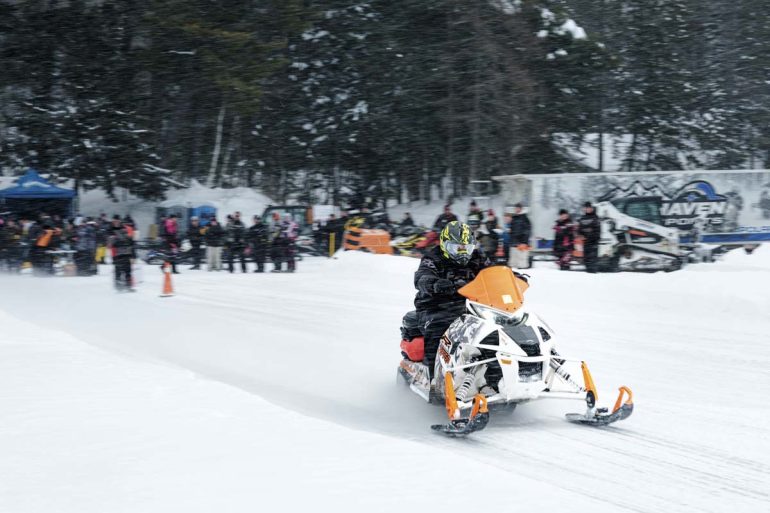 Photo by Alexi Hobbs
The Radar Run day looked a little different not too long ago. Not far from here, the owner of a local campground and RV park used to host a day of winter activities for cottagers in the area, including a track for snowmobiles to speed down. But they moved away. So Angelo took on hosting duties in 2023 and made a few changes, including adding the fundraising bit. “I love the work of preparing the track and getting everything together and being around other people who snowmobile, and since I like being outside anyway, I just thought, Why not do it as a fundraiser?” That year, about 300 people attended, and the money they raised went to a local food bank.
In year two, Angelo realized that the nearby Wilberforce Elementary School, where his son was a student, has a nutrition program that could really use the funds. “They do such great work with so little money, so I thought it would be great to help them out.” He enlisted the students’ help in making signs advertising the event and getting the word out about it. “Every sign we put up is made by the students,” he tells me. Turns out, that’s the key to success. That year, 2024, around 600 people attended the Radar Run, which raised $2,800 for the program. By the time this frigid day is done, they will have doubled the attendance figures and raised $5,020. Later, Angelo will tell me that the school administrators were in tears when he brought them the money.
I wait for the first snowmobile I see making its way down the track. “I’m a snowmobile person,” says local lake resident Robin Lee. “But I’ve never done anything like this!” Robin, 64, is practically floating. She has lived on the lake for almost eight years, but taking her snowmobile to top speed is something new to her. “What a rush!” she says, after her run. Radar reads: 87.9 mph. “What a feeling to have the space to just go, and there’s no one in your way.” Robin has attended the Radar Run festivities before, but this is her first time taking to the track. “I’m so happy to have this here. The stuff Angelo gets done for the school is so beautiful,” she tells me. “And all that work to clear all that snow that just fell. Can you imagine?”
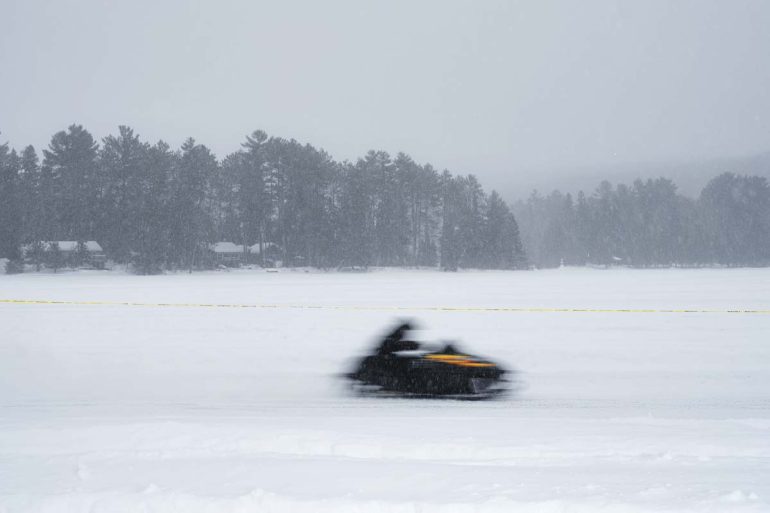 A “die-hard snowmobiler,” Angelo spends up to five days a week maintaining the track during the month-long prep for Radar Run day. The amount of work “really depends on the weather,” he says. “If the weather isn’t cooperating, then I have to spend more time.” The effort is worth it, of course. “I’ve gotten so much good feedback,” says Angelo. And the good vibes don’t stop when the riding does. “People stay late into the night and hang out.” Photo by Alexi Hobbs
Doubling attendance every year is no small thing, but the atmosphere of the Radar Run might be a clue as to why it keeps growing. This is an event that can easily be attended by both cottagers and locals in the area. The camaraderie and bonds created by the gathering are powerful, but so is the feeling that everything about the event is geared towards helping a local school. I ask Angelo if bringing together this many revving engines has ever been a noise bother for the neighbours, and he tells me they’ve never had anyone complain. “Everyone wants to be here, and they know it’s for charity, and so it has never come up,” he says.
Dan Risk and his family have seen first-hand how the Radar Run transforms the school. He was previously a school bus driver in the community—that’s how he heard about the event in the first place. But he’s also here to see his children, Max and Wyatt, ride. I ask Max, 8, what his favourite part of the day is. “Racing,” he replies succinctly. But what else could I expect from a kid named Max Risk? In his first run, he puts up 36.7 mph on the radar.
Meanwhile, Julia Watt is gearing up for her third run down the track. Julia, 20, is a nail tech at a spa in Lindsay, Ont., but she’s at Baptiste Lake every weekend. “I like that this is something I can do to bond with my dad,” she says. “I go shopping with my mom, and I go hunting or snowmobiling with my dad.” In her second run, she got a little over 51 mph. She’s noticing that this year’s Radar Run is bigger. “Last year, it felt like it was mostly people from the area—this year, I’m surprised at how many people drove with their trailers to be a part of it,” she says.
Julia and her dad, Dave, are among the small village that Angelo has enlisted to make sure the Radar Run is a success. There’s also Pat Smith—instrumental to set-up, says Angelo—and Rick Griffin, who “makes about a thousand phone calls to get sponsors for the prizes.” The prizes include gift certificates for local businesses and restaurants—though Angelo says some winners don’t even take them. “They just tell me, ‘Keep it, use it again next year,’ ” he says.
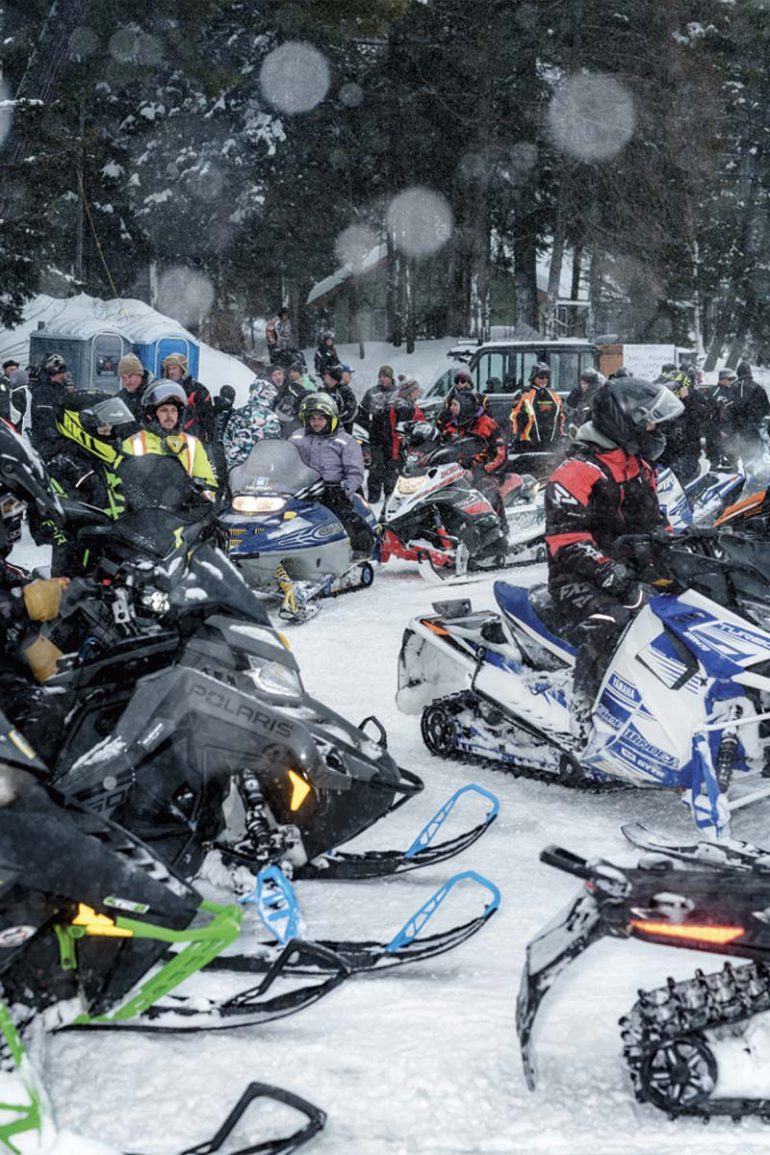 Radar Run prizes, donated from local businesses, are handed out in multiple categories, including kids and youth, plus categories based on snowmobile engine type. Photo by Alexi Hobbs
If some participants are showing up casually, on the flip side of the Radar Run experience, Jeff Bonsma is dipping his toes in the big leagues. He works pumping concrete, and he is entering for the first time. He owns a couple of sleds, but he has never entered because he didn’t have a snowmobile that was fast enough. Until this year.
Jeff is inspecting his snowmobile closely. “It’s custom-built and worth $15,000, but I got it for $10,000,” he says. I ask if that’s typical for race sleds. He laughs quickly and tells me, “Some of these guys have put $50,000 or $100,000 into their sleds. I’m just getting started here.” Jeff fires his new sled for his first run down the race sleds lane, and it’s a hell of a run: 114.5 mph, which elicits whoops from the crowd. But Jeff’s not happy with this result. “It’s running lean,” he says. “We’re gonna change the jets, get more fuel,” he explains to me. I take that to mean: he is going to change something in order to make the thing go faster.
By the time the day ends, the youngest snowmobiler down the lane will have been a 6-year-old, and the oldest a man in his 80s. The fastest sled will put up an astonishing 153 mph, which will drop the jaws of even the most experienced riders in the crowd.
A few weeks after the Radar Run, Angelo had a snowmobile accident on Haliburton Lake. He shattered his wrist and broke his leg. His initial healing didn’t quite work, and in a few months, Angelo will be having a second surgery to repair his leg, but he has no doubts that the Radar Run will return again next year. I ask him how he can be so sure. “There’s just no doubt about it,” he says, as if he has never entertained the alternative. “My son is old enough now that he can help out with the preparation. He can go out and get the track started,” he says. But it’s not just confidence in his son. He knows he can also rely on the small crew of people who all care for the success of the event. He knows he has built a community who care to see it thrive.
For Angelo’s 50th, he and 16 friends flew to New Brunswick, then snowmobiled back to Ontario. “You can say you’re not a snowmobiler,” he says, “but I promise it’ll change you if you ride across the Laurentians and through Quebec.” He pauses for a moment and adds, “On snowmobile trails, you get to see so much of the beauty this country has to offer—including parts you just can’t get to in any other way.”
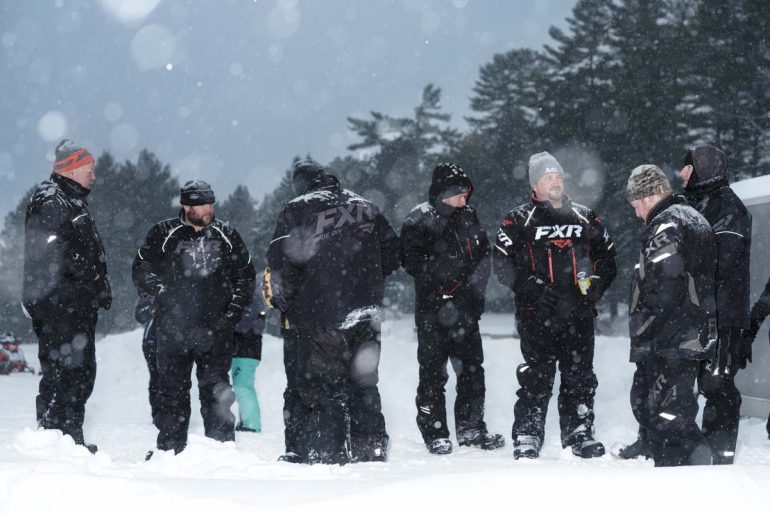 Photo by Alexi Hobbs
This is where, I have to admit, Angelo got me. Up until reporting this story, I had never been interested in snowmobiling and how it might expand my understanding of Canada. But the prospect that the country reveals itself to you anew because of snowmobiles is a notion I hadn’t considered before.
It made me think differently of that day on Benoir Lake. That the gathering despite the weather and all the labouring to make the track, it’s all in service of creating space to see awe together regardless of the season. It’s easy to sit before the joy of summer and take it in. It’s easy to associate shared laughter and togetherness with warm weather. But these people intrinsically know that you get to see one another in a different light when you have to choose to see them in winter.
I tell Angelo I’m going to check in with him after his next surgery, and he tells me that by then, he’ll be well into plotting the next Radar Run. I tell him I admire him for his dedication. What I mean to say is: I have a lot to evaluate about my willingness to disappear and withdraw during winter. I’m not quite ready to park on a lake. But when winter rolls around again, I’ll be a bit more willing to grab my warm gear and head out. That seems like a good start.
Writer and regular CL contributor Elamin Abdelmahmoud is the host of CBC Radio’s Commotion. He wrote “In a Big Country” in our August ’25 issue.
This story originally appeared in our Winter ’25 issue.
Related Story 6 winter words that don’t exist (but should)
Related Story Under the frozen lake, there’s much more going on than you’d think. Here’s a peek below the surface
Related Story Here’s why you should be pruning your trees in winter